Revenue Scaling
Today, I want to discuss revenue scaling, a stage that many startups never reach, as they often falter before achieving product-market fit. From a product management perspective, this topic is crucial. You might wonder why a product manager is focusing on revenue scaling when traditionally, sales, marketing, and customer success teams are seen as the drivers. While that’s true, I want to highlight how product management can be the catalyst for growth, empowering these teams to perform exponentially better. By doing so, organizations can scale revenue faster than ever. In SaaS, having a great product is just the beginning—it’s enough to achieve product-market fit, but not to scale revenue. We’ll delve into product strategy, go-to-market approaches, and cross-functional synergies to understand how product management can be the epicenter of growth.
But first, let’s address who is responsible for revenue scaling. Sales, Marketing, and Customer Success are often collectively referred to as “The Business Team.” Frankly, I dislike this term. For instance, during a roadmapping meeting, someone might say, “The business team is requesting this feature,” or during prioritization, “Let’s consult the business team.” This terminology creates a disconnect, making it seem like the product team is detached from the business, and discourages us from considering how the product can drive business outcomes. Our role is to solve customer problems that drive the business through our product builds. In essence, the product is the business. We need to connect our product initiatives to business impact and customer needs, and be vocal about it. We will explore how product management can play a crucial role in driving revenue growth by enhancing the effectiveness of adjacent teams.
Revenue scaling consists of three components: Volume, Quality, and Velocity. Volume represents the quantity of inputs driving your revenue, Quality pertains to the caliber of these inputs, and Velocity refers to how quickly you can transform these inputs into revenue. For new revenue, this means the number of leads you generate, the quality of these leads, and the speed at which you can convert them into revenue. Scaling involves increasing the effort you put in to multiply your outputs. Ideally, when you perform an action once, it should exponentially increase your revenue, and crucially, it should become easier each time you do it.
From a sales perspective, every meeting should ideally be easier than the previous one. For marketing, leads should come in effortlessly without excessive time and budget. From a customer success standpoint, time-to-value and value metrics should improve each time customers use the product. These aspects tie directly into the core metrics of SaaS. When sales meetings become easier, win rates increase. If leads are signing up easily, Customer Acquisition Cost (CAC) decreases. When your product is optimized for key use cases, time-to-value shortens, leading to wider adoption and a higher likelihood of customer renewals, enhancing Net Revenue Retention (NRR).
Three major obstacles can prevent a company from scaling its revenue:
- Faie
- Spreading product development efforts too thin as a result.
- Failing to address the most critical and unsatisfactory use cases for the end-user, even if the product is purchased.
The Sales Velocity Formula
So, how can you relate product strategy to revenue scaling? We can use the revenue scaling formula named with the sales velocity formula.
Sales velocity = (# of opportunities) x (win rates) x (average deal size) / sales cycle
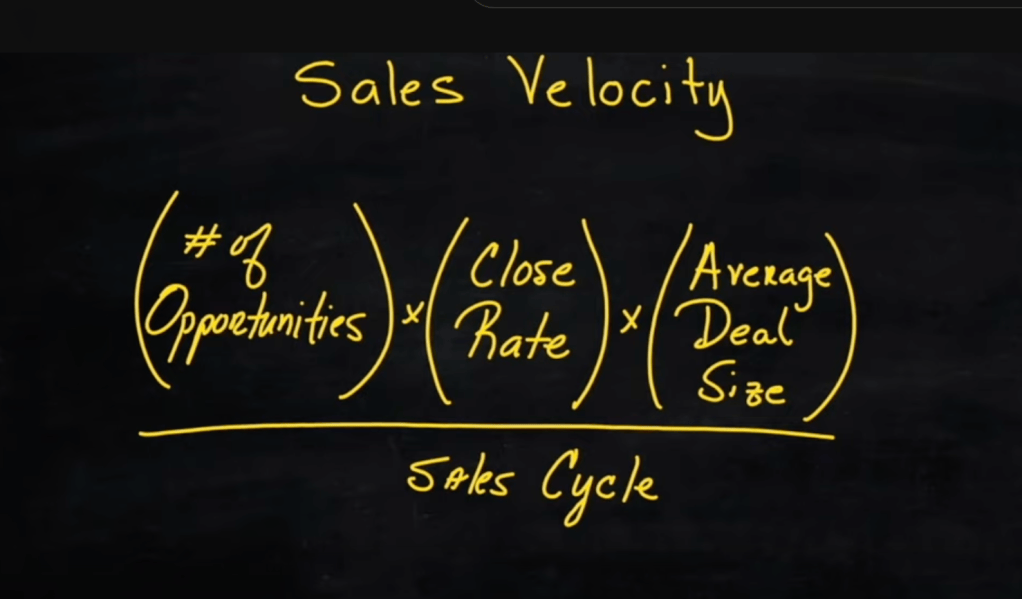
Sales velocity is a key metric that measures the speed at which deals move through your sales pipeline and generate revenue. It’s an essential performance indicator for sales teams, providing insights into how quickly your business is making money. This concept is closely tied to revenue scaling, as all the inputs into sales velocity act like fuel for your revenue engine. The interplay between these inputs determines not only how much money you earn but also how fast you earn it. As a business, your goal should be to continuously optimize these elements over time.
At a glance, marketing is responsible for the number of opportunities, sales for the win rates, and product marketing for the average deal size based on how you package your product. However, the question arises: as a product manager, how can you influence these metrics, and is it even possible for a product team to impact them? Let’s explore this further.
[Insert example]
Strategic Shifts for Revenue Scaling
- Early Market: Focus more on a sales-driven approach to secure early adopters and generate initial revenue.
- Chasm Crossing: Shift towards a market-driven approach to align product development with market needs, ensuring the product appeals to the mainstream market.
- Sustainable Growth: Continue to balance both approaches, using market insights to guide product strategy while maintaining strong sales efforts to drive revenue.
Helping Sales to win more deals and close them faster
Spread too thin
Here’s what often happens: sales teams engage with potential customers and, to close a deal, they present a list of requested features to the product manager. This is a common scenario for product managers. You can’t blame sales for pushing hard to generate revenue, so how should a product manager approach this?
Some might blame sales for not selling effectively, while others might criticize them for entertaining every customer request. This is known as a sales-driven effort, where the focus is on closing individual deals, customer by customer. This approach can be effective during the initial product launch when you’re seeking early adopters and testing your product’s fit in the market. However, to achieve revenue scaling, a shift to a market-driven effort is necessary. Sales driven effort is the reason why # of opportunities, win rates and sales cycle never improved.
A market-driven approach emphasizes winning over a market segment as a whole rather than individual customers. This requires a strategic shift in product management to focus on understanding and addressing the broader needs of the target market. By doing so, you can create a product that resonates with a larger audience. What you want is to develop a roadmap that satisfies a market, which once you’ve done with it, selling is just a matter of getting the deals done.
Pick the playfield you want to be in.
To ensure that the next sales meeting gets easier, it’s important to shift away from the mindset that every customer request is a revenue enabler. Identifying this shift requires a close examination of your win-loss data and a refresh of your Ideal Customer Profile (ICP).
Best possible scenario, if you really have the data, is first to identify industry or segments that require or not require feature request. To see how much so far you have been able to complete the product set for a particular industry.
Once you identified your Ideal Customer Profile (ICP), the next step is to create a roadmap that supports scalable revenue. In B2B, the challenge is often not about what to build but rather “when” to build it, as customers will eventually expect a comprehensive solution that addresses their entire business process.
To achieve this, it’s essential to develop an industry-specific roadmap that ensures you serve the market effectively. This isn’t as straightforward as creating a generic roadmap for the “Manufacturing” industry; you need to consider the specific use cases within each industry. Fortunately, in most industries, these use cases are closely tied to how they conduct their business, including specific operational models, policies, and departmental structures.
For example:
- Manufacturing: Within manufacturing, there are various use cases such as Make to Stock, Make to Order, and Assemble to Order. Each of these use cases requires specific features and functionalities that cater to different manufacturing processes and customer demands.
- Purchasing: In purchasing, the roadmap should address both sourcing and purchasing steps. It should also differentiate between indirect procurement (for goods and services not directly tied to production) and direct procurement (for raw materials and components needed for production).
- Trading: For trading businesses, the roadmap should consider the needs of distributors and pre-order business models. This could include features for inventory management, order processing, and logistics to support different types of trading operations.
In a different scenario, if your efforts are spread too thin, here’s how your roadmap might look. Each initiative would be focused on different use cases and industries, leading to a fragmented approach. During sales meetings, more gaps will be identified, which will end up in the customer requests pipeline, perpetuating a continuous loop of patchwork fixes which negatively impact the win rates and sales cycle.
It’s not that growth is impossible with this model; it’s just much harder. Each subsequent sales meeting will uncover more gaps, making it increasingly difficult to close deals efficiently. This is the opposite of what we aim to achieve in revenue scaling, where the goal is to spend effort and achieve multiplier results, making each subsequent action easier and more impactful.
To scale revenue effectively, your efforts need to be concentrated and strategic. By focusing on key industries and their specific use cases, you can create a cohesive roadmap that delivers significant value. This focused approach ensures that each sales meeting builds on the last, closing gaps and reducing the need for constant adjustments based on ad-hoc customer requests.
Roadmap sequence as a revenue booster
The next critical step is sequencing your roadmap effectively. It’s important to release features consistently across quarters, rather than just at the end. Your sales and marketing teams view feature releases as essential tools for increasing leads and win rates. The earlier these features are available (and they are important), the higher their confidence in your product and their ability to close sales deals.
Think about the whole product & adoption blocker
In a sales-led model, especially during the customer review stage, customers evaluate your product as a comprehensive solution, not just based on specific features. Selling SaaS products in Indonesia is akin to selling real estate; you need to highlight the full spectrum of your product’s attributes. Customers are looking for the best price-to-value ratio, and they will scrutinize all aspects of your product.
In real estate, you would advertise proximity to toll gates, swimming pools, clubhouses, playgrounds, and jogging tracks—even if these amenities aren’t used frequently post-purchase, they are crucial during the deal stage. Similarly, in SaaS, showcasing a broad range of features can make a significant difference in closing deals. Highlighting these attributes can provide a competitive edge, making your product more appealing and demonstrating its comprehensive value to potential customers.
Helping Marketing to get more leads
The Role of Product Management in Marketing Strategy
In the realm of product management, influencing the number of opportunities available to your marketing team is crucial. While strategy and tactics are typically the domain of your marketing colleagues, product managers play a foundational role in setting the stage for effective marketing strategies. In a crowded market, differentiation is the key factor that ultimately shapes your market positioning. The more distinct your product is, the easier it becomes for marketers to generate and attract high-quality leads for your sales team to convert.
Three Operational Models for Product Development
For a product development team, there are three primary focus areas or operational models:
- Differentiation: Setting your product apart from the competition.
- Neutralization: Catching up with competitors by matching their features and capabilities.
- Process Optimization: Enhancing internal processes to free up resources for differentiation or neutralization efforts.
| Work | Core Value | Metrics | Challenge |
| Differentiation | Separation | Unmatchable | How Far? |
| Neutralize | Comparability | Good Enough | How Fast |
| Internal Process | Productivity | Best in Class | How deep? |
The Importance of Differentiation
In this discussion, let’s focus on differentiation and why it is vital for your marketing counterparts:
- Market Positioning: Differentiation establishes your product’s position in the market. Are you a low-cost player, or do you offer unique, premium features that set you apart?
- Market Segmentation: Differentiation also helps segment the market. Different segments will perceive your product differently based on its unique features and value propositions.
How to build differentiation
One effective way to view your product differentiation is through a vector lens. This approach considers your product differentiation as a continuous progression in a specific direction, providing a measurable perspective for both the competitive landscape and customer segments. Essentially, customers “select” the vector they value most.
To build real differentiation, you need to intentionally incorporate it into your roadmap as a central theme. Examples of vector differentiation include:
- Modularity: Offering customizable modules to fit diverse needs.
- Ease of Use: Ensuring the product is intuitive and user-friendly.
- Integration Between Modules: Seamlessly connecting different parts of your product.
- Integration with Other Products: Ensuring compatibility and interoperability with other tools.
- Improved Productivity: Enhancing efficiency and effectiveness for users.
- Time to Live: Reducing the time required to deploy and use the product.
Embedding Differentiation into Your Roadmap
In your roadmap, it’s crucial not only to develop fundamental features for the market but also to embed differentiation into these features. For instance, when building features X, Y, and Z, consider how to incorporate modularity, ease of use, or other differentiators.
Additionally, set specific OKRs (Objectives and Key Results) to align your roadmap with strategic decisions towards differentiation. Continuously deepen your focus on the selected vectors until you achieve significant separation from the competition. This separation clarifies your product’s core positioning, making it the top choice in the market.
Benefits of Clear Differentiation
When your product differentiation is well-defined:
- Lead Generation Becomes Easier: A product with a strong personality and clear advantages stands out, making it easier for marketing teams to generate leads.
- Tailored Marketing Campaigns: Marketing teams can create more focused and effective campaigns, confident in the product’s unique value propositions.
- Reduced Effort in Storytelling: Marketers won’t need to stretch their imagination to create compelling stories; the product’s clear differentiation does the heavy lifting.
By adopting a vector lens approach to product differentiation and embedding it into your roadmap, you can ensure your product shines in a crowded market, driving better results for your sales and marketing teams.


Leave a comment